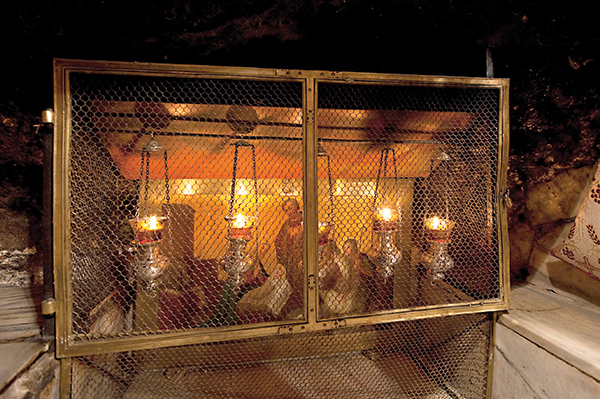
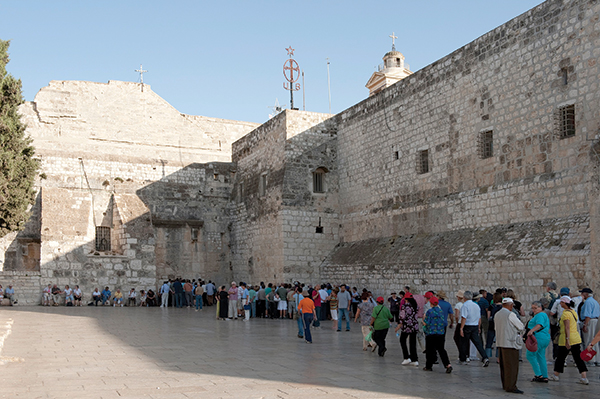
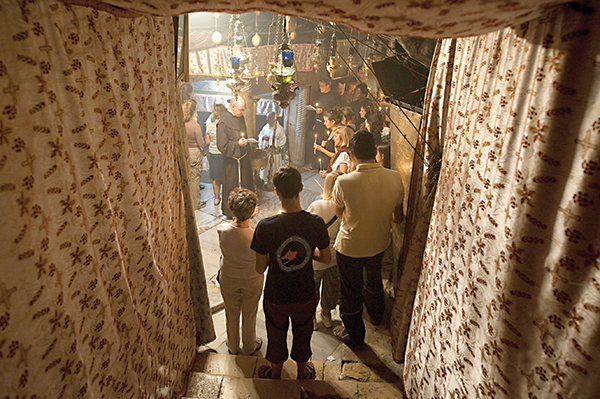
Tourists taking part in Holy Land tours often make their way to Bethlehem, wanting to set eyes on the iconic cave where Jesus is said to have been born. The majestic Basilica of the Nativity with the Orthodox, Armenian, and Latin churches within its walls evokes spiritual experiences in many who visit. It is not uncommon to hear groups of visitors singing hymns when gathered in the caves under the basilica, while, for others, a sense of stillness is evoked. Both are reactions flowing from people’s connection with the story of the place. Although many tourists might not be aware of the intricate layers of histories of Bethlehem, the story of Jesus’ birth is often interwoven with their own personal histories.
A tourist from the United States, whom I recently encountered in Bethlehem, told me she experienced a feeling of belonging, a feeling of “knowing” this place that was in reality very “out of place” from what she was acquainted with in North America. Interestingly, she recognized that this was to do with how much the biblical stories of Bethlehem had been ingrained in her.
Bethlehem, as a town, can benefit from the spiritual connection many tourists have with it. The biblical story might not always be the most complete rendition of Bethlehem’s history, but that is something that can be adjusted over time. Fact is, most tourists have a spiritual interest in Bethlehem. What do we mean by spiritual? A simple dictionary definition of the word offers us two options. First, something that is of or concerning the “spirit” as opposed to “matter” and, second, something that is inspired, refined, sensitive. I am particularly taken with the second part of this definition. Spiritual tourism means becoming inspired, being affected through one’s senses, and so, through experience, becoming part of the story of the place you’re visiting. Palestine, Bethlehem especially, lends itself to that experience par excellence.
♦ Bethlehem University’s mission is to serve the Palestinian community through education. At the Institute of Tourism and Hotel Management, the university is now doing that by engaging the private and public sectors to develop unique academic programming geared towards fully utilizing Bethlehem’s distinct tourism potential.
Unfortunately most visitors are robbed of the opportunity to explore that spirituality of inspiration and sensitivity while here, simply because they do not spend enough time in Bethlehem. The political situation has resulted in deliberate fearmongering where tourists are told it is too dangerous to walk around in Bethlehem. They are bussed in to see the Nativity Church and then immediately taken back to Jerusalem.
Bethlehem University has been asking the question how, as an academic institution, we can contribute to a thriving religious tourism sector in Palestine, and Bethlehem especially. The past few years have been marked by consultations with the private and public tourism sectors to map the religious tourism market in Palestine. One of the outcomes of this benchmarking process is the realization of the need for high quality vocational training programs that educate Palestinians to work in the tourism and service industry. Since then, the Institute of Hotel Management has launched a new academic and vocational curriculum that is geared towards delivering the highest standards in the field, ranging from front-office management to food safety practices and culinary arts. Future plans include a state-of-the-art training hotel and restaurant in the former hospital and Handal House at Mount David in Bethlehem’s Old City.
♦ Spirituality is an important aspect of the philosophy of the De La Salle Christian Brothers, a teaching congregation founded by Jean Baptiste De La Salle three centuries ago. Bethlehem University embodies the Lasallian vision and innovative spirit, centering on personal relationships and academic excellence.
The almost two million visitors who make their way to Bethlehem annually need to have the most positive experience possible. With religious tourism worldwide on the rise – currently estimated at 300 million travelers spending an estimated US$18 billion every year – we need to have a Palestinian response to that growing market. We have amazing religious and cultural assets in Bethlehem, but as a community we need to make sure that Bethlehem has an appeal to travelers beyond those common landmarks. Generating income for the Bethlehem community is largely dependent on travelers not leaving Bethlehem immediately after their visit to the Nativity Church. That requires a comprehensive and high-quality service sector.
Bethlehem is uniquely cut out for inspired, experiential tourism. High-quality services will attract longer stays, which will stimulate our local economy. For visitors, staying in Bethlehem longer will give them the opportunity to interweave their spiritual stories with the real stories of our town: stories of distress, but also of hope and resilience.
» Annerieke Willemze has an MS in cultural anthropology from Utrecht University in the Netherlands. She lives in Bethlehem where she works in the Advancement Office at Bethlehem University. Annerieke can be reached at willemze@bethlehem.edu.
Article photos from Palestine Image Bank.