Fafi, Tant, Luti, Naua’m, Banoteh,* and the list of slurs goes on. Words or, more aptly, verbal abuse that echoes on the walls of my conflict with the ideal masculine society of mine. The conflict in which “Me the different” is represented in the way I talk, walk, dress, behave, and address, and my adoption of pinpointed ideas which en bloc are inadmissible in the definitions of my Masculinized-minded society, or rather exotic when compared to what is accepted and expected from a male-born creature. My voice, body language, nuomeh (softness), and choice of clothes are inconsistent with the masculine pattern that each “penis-born human” should adopt instinctively without claiming any difference that is not in line with this pattern.
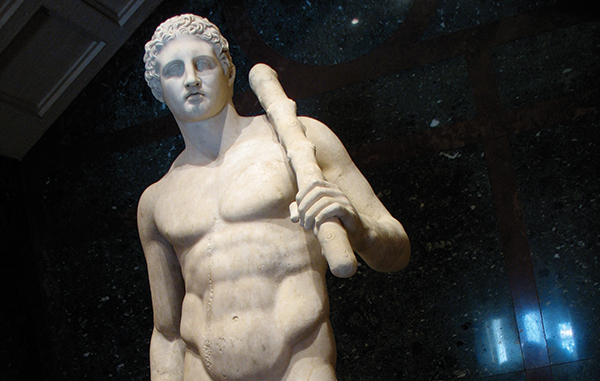
Let me introduce you to or remind you of some of the Arab standards of the manly man: a husky voice, hands, and behavior (let’s ignore the testosterone role; it means nothing in the masculine connotation of my society), a smoker, a troublemaker (or physically prepared to fight and win), a hunky body, a violent attitude, and most importantly, disdain for women’s rights (don’t allow them to overcome your masculinity); and let us not forget that traditional male role of being heterosexual. Be aware, Dear Reader, that masculinity is also an idea that oozes through the peels of all genders in my society. It metastasized like cancer, overwhelming all the enrolled under “ideal masculine man,” which had always included women.
I remember once reading an essay on self-reliance in which the author talks about how people tend to conform to the society in order to survive, and that people disguise and conceal their true selves. This pushed me to ask myself what it means to be in such a society where gender stereotypes are the Avatar worshipped. Do I have to be consistent with the society in order to fit in? Can one be him- or herself in this society where there is no Grey; but solely Black and White, solely a masculine man and a feminine woman? To what extent can I be me, yes me, the one with the soft voice (ironically, sometimes my Mom used to call me Dallal el-Hisbeh** – but it was just because I tried to mask my voice), the one who dresses like himself, behaves serenely, the one who despises violence and refuses to engage in fights, the one who can defend women and LGBT people and not be judged for it, though occasionally categorized as one. Does being me mean that I should lead a revolution against the Masculinized-minded people? Or should I mask my self-everything to be part of such a society, should I lose myself and be bound by the traditional masculine model? Should I fight the monster of the masculine paradigm but be aware of not becoming one? Should I create my own connotations of Masculinity and manhood, or simply succumb to the common ones?
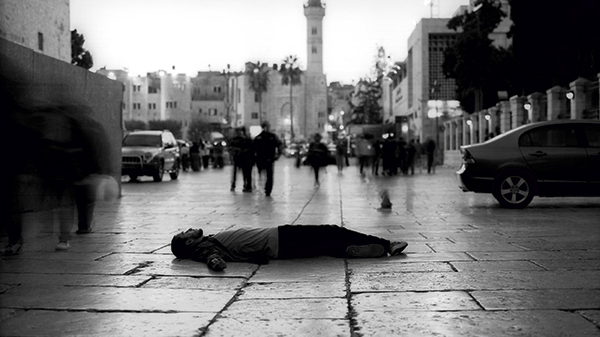
Masculinity in my society adopts multiple faces; nevertheless, it is based on one exclusive rule that is universally applied to all of society. I grew up hearing that utter justification of Arab society that allows people to glorify the gender stereotypes, where the masculine men are responsible for the hard work, and the feminine women are for child-bearing and housework. Here there is no room for an in-between gender, e.g., an androgyne*** doesn’t have room to express both qualities in him or her. The gender-biased society manages to banish any anti-masculine rights, gender expressions, or sexual identity. Anti-masculine rights had always included women’s rights – though recently these have been diminished – and moreover, the various “Me” rights. The conflict of being yourself, the different self, is exacerbated when you live in a society where men’s bodies are publicly accepted but women’s bodies are haram. Yes, the world has changed, and women nowadays in my society have greater freedom and more space in the “Masculine” society. However, this space has increased the need for more affirmation of the notion of masculinity. With the more powerful role of women, the role of Masculinity is challenged, and consequently, the burden weighs heavily upon me – “I” the “epicene” – who is deemed to be far removed from the traditional masculine model in my Masculinized-minded society, upon any anti-masculine figure, where there is no Grey.
In my masculine society, everlasting conflict seems inevitable in the different stages of my life. It all started in my house where my parents had always compared me to my cousins. They would say, “Deepen your voice, straighten your walk, and be more aggressive.” Even now I can hear my dad saying, “I want you to be a man!!!!”
I know this look on your face, Dear Reader. I didn’t know what the hell this meant back then. I can remember how many times I tearfully sashayed to my dark room, or worse, I used to sleep in our backyard, shedding more tears, crestfallen and intoxicated with the tears of blame. Dad, I blamed myself for not being the “Man” you wanted, I blamed myself for not being “that guy.” Remember him? The tall, husky-voiced guy with the huge muscles that covered his body; the one to whose Virility you chanted praises! Over and over again, I beseeched God in my prayers to grant me a miracle – that somehow I would wake up and find myself just like “that guy.”
Dear Reader, allow me to tell you that I love and appreciate my family; but this doesn’t mean that I don’t have the right to write you now in words of extreme exasperation towards them for every free-fall that my soul experienced whenever they engaged in comparisons that were used against me, an outrage to the whole damned masculine discourse!
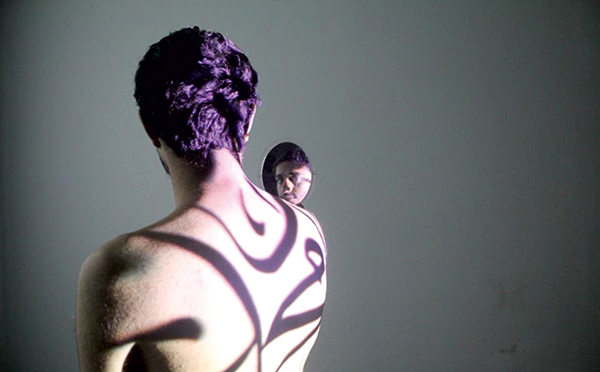
I remember how I chose to mask myself in a way that guaranteed me a seat in the masculine theater or the possibility of being cast for their masculine play. I remember how I used to deepen my voice when I talked to my parents, how I had echoed this same voice in the other stages of my life, in junior high and high school; and now, I remember how I sometimes used to drop my plan to wear skinny jeans and Topsiders, and instead wore “baggy” and huge boots to avoid the judgmental insinuations. How I had to add some muscle. Yes, Dear Reader, I tried more than once to go to the gym to build my psyche before my body. It seemed easier to reduce the Fafi pre-image of mine if I looked more bulky!
In this society, the moment we are born is the moment of a new reincarnation of masculinity. However, the word “born” calls for a halt to thinking and learning to accept that people are “born” differently and that they are not made of the same clay, labeled “Masculinizing clay,” and that selves have the right to be their own, not selves that seem bound to the DNA of a masculine ancestor and passed along to all genders indiscriminately! After a long process of learning how to perceive myself differently, I realized, Dear Reader, that it is a process that fluctuates off balance by social taboos and expected images of people. It’s a process of self-acceptance of differences, it’s a process of self-perception, and it’s a process that might deplete you while trying to apprehend it. It’s a process of coming out, not because you need to come out, not because it’s for the society, but because it’s for you. Although it’s a process that takes much from you, it might eventually give you You. It’s a process of feigning selves, a process of labeling, a process of self-abhorrence, a process of coping with the society. Sometimes you will be revolutionary, and at other times you will have to walk alongside the wall until you are able to take tiny baby steps, and in my case, come out as Grey.
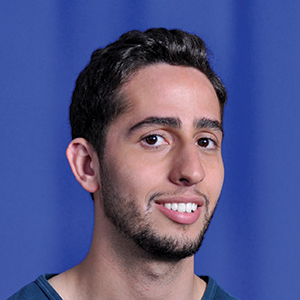
» Abdullah H. Erikat is a senior biology major at Al Quds Bard College. He is passionate about and dedicated to research and academia. His research interest focuses on cancer biology. He is also passionate about writing and is a self-proclaimed bookworm, to which many of his friends can attest. He is interested in art, writing, gender and sexuality, and the social discourse.
Article photos: courtesy of Mahdi Baraghit
* Words from my society: Fafi, Tant = sissy; Luti = fagots in the most insulting way, more professionally it means queer; Nua’om, banoteh = womanly.
** Dalal el-Hisbeh is the man who sells vegetables in the market, who has a rough and very loud voice.
*** Androgyny, is the blending of feminine and masculine attributes in the same individual. (Virginia Woolf, studies on gender, lesbian, gay, and queers.)