Every time I am abroad, I make sure to introduce myself by pronouncing my name with a stress on the r, just as it would be said in Arabic. I emphasize the r, lest these foreigners betray my identity by twisting their tongues. Lest I betray my identity by accepting that insipid swirl.
If I am honest, Palestinian identity is even more contorted than a tongue rolling upwards.
Growing up in the era of the second Intifada, I was introduced to Palestine through the scope of revolutionary songs blasting on every Arabic media station, with images of bloody streets and blazing trash bins on every street corner.
One time in the early years of the second Intifada, as my mother and women from the neighborhood gathered on our balcony, a young man in a black shirt and jeans ran up the street, his mother yelling after him, “Yumma, take care of yourself. Yumma, don’t get carried away.” He smirked and shouted back “I’m only going to do my duty, Yumma.” Turning around he kissed her forehead, never to return.
 During my adolescent years, my grandfather would sit me down for coffee dates and narrate events from the past. He would recount stories of his 18th birthday, over and over again. Looking back, I think he was afraid to release the phantoms of that memory lest they eat his aging body. Wearily, he would chronicle the slaughter of his father by a Zionist bombing near Yaffa Clock Square, bitterly explaining how adulthood greeted him with decapitated limbs. “One arm was still in his jacket,” he would say. Mulling over that, he would always drift off, narrating in pieces – he, like that tragic bombing, severed the story. A section for each limb.
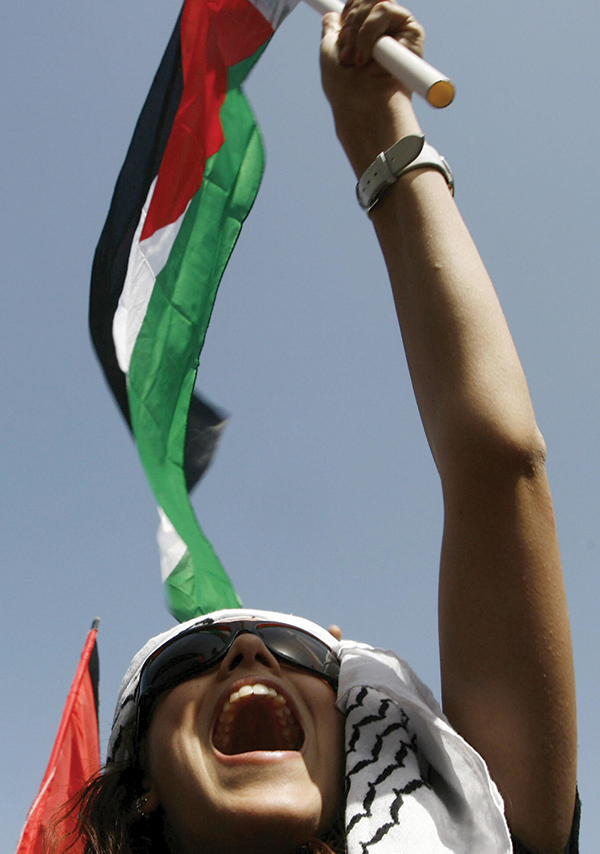
His stories were always morbid, bloody, packed with death, defiance, battles, prison, soldiers, confrontation, feda’yeh, the resistance fighters whose names we memorized and those we will never know of. Both disturbed and bewildered I would write down all the details, documenting the names of brigades now null, and mountains now homes to Israeli colonizers. “Memorize these stories, Mariam,” he would command. “This land, these mountains, this history, is you.” From then on, I would become the lamented past, and the inherited nostalgia. I am the daughter of exile and resistance. I hit the streets and began to protest, because that is what a Palestinian grows up to do: you are the disgruntled ones. The frustrated ones. The oppressed ones. You are the uprising. Anything you do, in education, accomplishment, economic success, is for the cause.
♦ Palestinian identity is rarely separated from its national history and the concept of struggle. The Palestinian post-Oslo-Accords generation has often found itself growing up between the stories passed on from our grandparents and current nostalgia for an embellished past. Realizing the binaries of personal and collective, Palestinian identity transcends the narrative of resistance.
Concurrent to my grandfather’s continuous storytelling was my grandmother’s silence. Her refusal to engage in these coffee dates. I would assume that it stemmed from disinterest. She would grimace at my grandfather’s annals and excuse herself from the table. I thought it was a form of betrayal. Treason. In my adolescent arrogance I would grow to loathe her absence from these conversations. One day, however, as she was making tea she posed a question that continues to loom over my restless nights. “Mariam, do you know what it means to be Palestinian? Do you think your going to these protests makes you Palestinian?” The silence following that question pierced any certainty I had of who I am and what I associate with.
The characters from my grandfather’s stories turn to silhouettes on the wall, obscuring any sense of reality I possess. Identity, so fluid a concept its waves can carry you to an abyss, and you will spend the entirety of your life trying to swim upwards for air.
The current discourse of Palestinian history almost always relates to resistance, endurance, and suffering. Due, but not exclusively, to exile and the division between Palestinians, our oral history passed on from our forefathers is what we have in common. Although currently it manifests in different forms, suffering, and our reaction to it unites us.
Today, going to jail and dying as a martyr is hailed as a badge of honor amongst Palestinians. Yes, it is essential to disallow the oppressor to break our will. So we redefine the dynamics of incarceration and death in order to cope. Consequently, we strip ourselves of the personal and what remains is a disintegrating collective. A divided collective fused with the rhetoric of national obligation. To be Palestinian is to endure and resist. Exhaustion is not an option. Living is fighting. The collective. Protect the collective.
Responsibility has become the only heirloom of this inherited cause. Oddly enough, it is for this very reason that we draw the will to live, to continue fighting. To be free, of colonialism. Of duty.
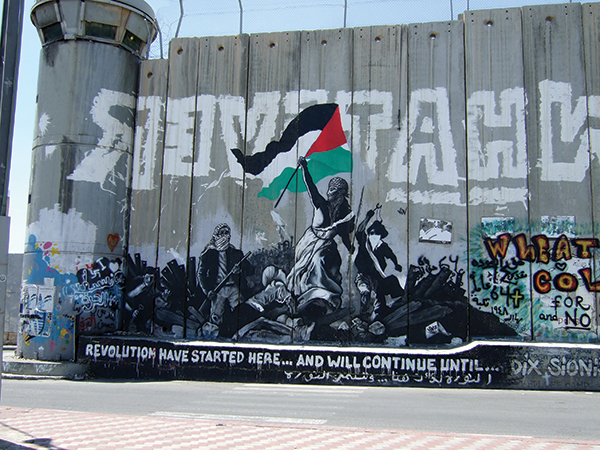
After my release from jail, I was lauded for my “bravery.” Across my university campus were posters with my face sprawled across the walls. I couldn’t recognize this young girl. Who was she? What was she doing staring back at me? Where did that pompous smile come from? Like a madwoman I would rip every poster in sight. Students witnessing this act would stare, unaware that it was me in the photo. The whispers piercing my ears. How dare she disrespect our prisoners? What is she doing? Who is this crazy girl? Some of us sacrifice for this land and others taint it.
What is being Palestinian but the memorized stories of our grandparents and parents embellished with poetic jargon shoved between the hurt, love, joy, blood? What does it even mean beyond the expectations of resistance? Without the glorified heroes and martyrs used as poster icons for jingoistic factional campaigns. When the discourse becomes void of lamentation and glamorized struggle what are we left with?
To be Palestinian is to love so intensely you begin to reek of absolute misanthropy.
A loathing and a fear of loathing. Lest it be an act of treason. Lest you betray your cause. Lest they pronounce your name with an R and a tongue rolling upwards.
“Sido, what does it mean to be Palestinian to you?”
“Mariam, I’m too old for this.”
» Mariam Barghouti is a Palestinian student of English literature at Birzeit University. She also contributes op-eds commenting on Middle East politics. Her work has been published in The New York Times, Al-Jazeera, and Huffington Post.