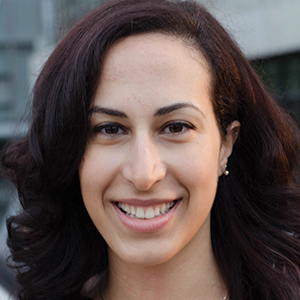
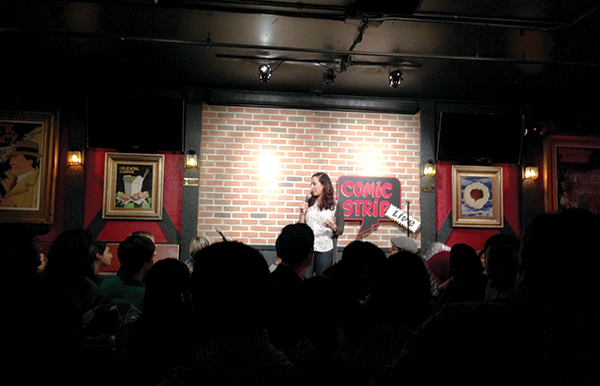
One ill-advised evening in 2008, as a first-year grad student, I decided to go to an open mic and release the jokes I fearfully held captive on my hard drive. It was already a surreal experience, made even more so by the performers and the venue. It was a dark, dingy room in an underground space on a busy touristy street, appropriately located in the East Village in Manhattan. I took my best friend, and unbeknownst to us, this open mic attracted a hodgepodge of strange performers, even by New York standards. Here I was a Palestinian girl from Alabama trying to make hippies with guitars laugh. It was all a blur and I was too nervous to really remember it. I just remember thinking, “Well, that’s out of my system.”
Given my upbringing as a Palestinian Muslim raised in Alabama, winding up as a stand-up comedian shouldn’t really surprise me. I’ve been a fan of comedy for as long as I can remember, and while most kids my age watched cartoons, I was enamored with sitcoms such as I Love Lucy, Mary Tyler Moore, and, of course, The Golden Girls. I looked up to these funny women in leading roles. As I grew older, I started watching Comedy Central stand-up specials with jokes far too mature for my age.
When it came time to start looking into graduate schools, New York was on my radar, and I went to visit a few times. After some days, I felt more at home here than I ever did growing up in Alabama. The chaos, crowds, loud taxis, and foreigners everywhere felt like Ramallah, with fewer checkpoints and more Jewish people. I won free tickets to a comedy club in the West Village and I was hooked. I was mesmerized by learning about people’s lives through jokes that effortlessly made people laugh. My newfound obsession led me to the New York Arab-American Festival in 2007, and I was lucky enough to see a performance by the founders, Dean Obeidallah and Maysoon Zayid. It was inspiring. Seeing other Arab-American comedians telling jokes about life experiences that were similar to mine made me realize that this was something that I wanted to be a part of. I moved to New York in August 2008 to pursue a master’s degree and wrote jokes for the festival but kept them hidden on my computer. I couldn’t get over my stage fright enough to send in an audition tape.
♦ Being a Palestinian living abroad often means creating your own definition of home and belonging. Although many Palestinians in major cities find Arab communities in which to assimilate, growing up in Alabama made that a little harder. Performing stand-up comedy brings these two dichotomous backgrounds together in a way that others can relate to. Telling jokes on stage and sharing this unique perspective with a Western audience gives a glimpse into what it really means to be a Palestinian-Muslim female in America.
Growing up, I was goofy and always trying to make my family laugh, but outside of our home, I was more reserved and hated any kind of public attention. Giving presentations, acting in school plays, and even karaoke made me anxious. I’d like to formally apologize to anyone who’s had to witness the latter.
After that bizarre night in the East Village, I waited an entire year before I got up on stage again, but this time at a comedy club, with just comedians. It went a lot better, but I was still terrified of the stage. Fortunately, my friend suggested that we take an improv class at Magnet Theater. I thought that being on stage with other people and in a class with my friend might ease the discomfort, and it did. I loved improv and the community, but the idea of being on stage alone while telling jokes still seemed too scary.
But by 2013, I was tired of holding myself back and decided that it was time to finally pursue my real dream. I wrote and re-wrote jokes, hit up several open mics, and made an audition tape for the festival. I was thrilled to have gotten accepted and it cemented my desire to keep performing. I have continued to perform at the festival ever since. I’ve also performed several times in the Big Brown Comedy Hour, a stand-up comedy show started by Dean Obeidallah that features “brown” comedians from various ethnic backgrounds in New York City. I’ve also performed at fundraisers, charity events, random shows all over the city, and even a show in my friend’s living room. Last year, my friend and I started our own monthly stand-up show, the Shady Pines Comedy Hour (appropriately named after a retirement home from the Golden Girls).
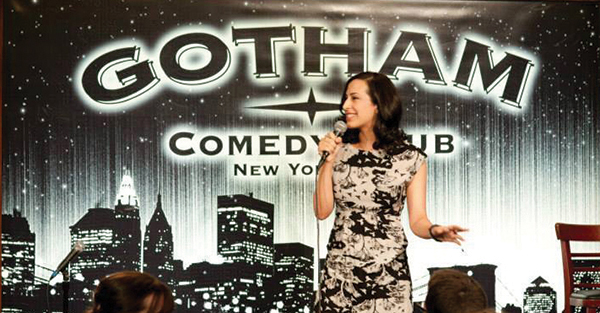
Many of my jokes are informed by my background. Having lived between Ramallah and Alabama throughout my childhood and adolescence, some jokes practically write themselves. It’s also important to me to bring to the surface the occupation in Palestine and give voice to Palestinians through comedy. For example, I have a couple of jokes about the Separation Wall and denying entry to an Israeli guy who was hitting on me in New York.
With the way Arabs and Muslims are portrayed in the media, it’s also important to me to dispel the stereotypes that people have about us. To some people, even seeing an Arab-Muslim female doing comedy is surprising. Just being a female doing comedy can be difficult enough, as it is typically a male-dominated field. It can be hard for people to see women just as comedians without the female qualifier. There is an ignorant misconception that female comedians are not as funny as their male counterparts. I would vehemently disagree, as several of the comedians I have on my show are hilarious women.
Speaking of funny women, my favorite is my mother, who inspires several of my jokes and graciously laughs at my impressions of her and the funny things she says to me. When I’m not talking about my upbringing or my mother, I do general jokes about everyday life events. That’s the beauty of comedy. It’s an expansive reality that we can see across the new generation of talented comedians who are popping up all over the Middle East. I am so proud to come from the cultural richness and diversity that is Palestine. We must continue to express that and demonstrate non-violent resistance, whether it is through poetry, dancing, acting, writing, singing, or comedy.
 Writing jokes and being able to see the humor in situations serves as a method of coping and processing the strange world around me. I used to avoid potentially weird and awkward social situations, and now I almost welcome them because they might make a great joke one day. This has drastically improved my perspective on life.
The experience of performing comedy, overcoming my fears, and pursuing my dream has really been life changing for me. The feeling after a good show and making a room full of people laugh is incredibly powerful and unlike any other feeling. Many comedians will tell you how addictive it is. Being able to make people laugh feels good, but when someone comes up to me after a show and says, “I relate to what you said in that joke,” or “I also grew up as the only Arab in my school and I had a similar experience,” it makes me feel connected. At the end of the day, we all just want to feel connected to something or someone, and comedy is just one of the several mediums available to do so. Comedy is not just about laughter, it’s a way to bring people together by talking about shared experiences, which makes us feel less alone and part of something greater than ourselves.
» Atheer Yacoub is a Palestinian-American who grew up in Alabama and the West Bank. She now lives and works in New York City, where she also performs stand-up comedy.