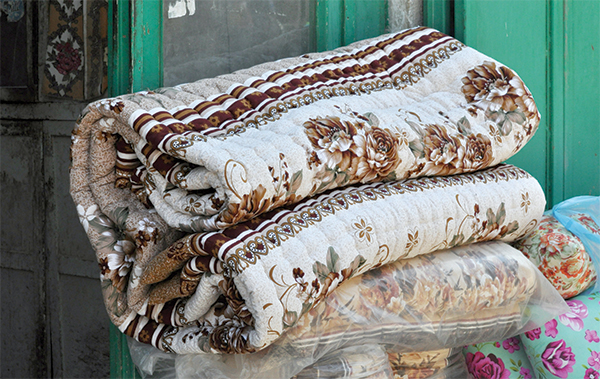
In an ancient shop in the old city of Nablus, he hugs the duvet with care and determination. His needle goes in straight rows, threading along the duvet cover to the fluffy wool that fills it. The needle obeys his rules: be smooth, soft, committed, and loving.
Thirty-five-year-old Nizam Muna, the last wool-bedding maker in Nablus, begins the conversation: “If you look into the shop from outside, you would think that my job is boring and useless. This would only be true if you don’t really understand what my job entails.”
In a big souk like the one in the old city of Nablus, this shop could change hands frequently. However, Al-Haj Eskandar’s Wool-Bedding Shop has stood the test of time for more than 150 years. “It has been my own business for 31 years now. I inherited it from my father, who took it from his uncle, who was likewise taught by his uncle. This is our family business,” says Nizam.
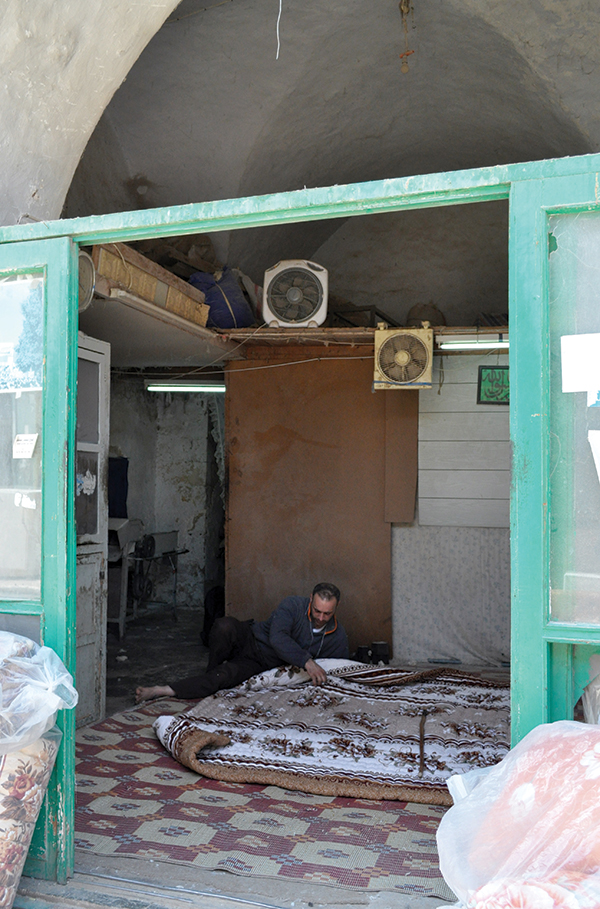
“I was a little boy when I used to come to the shop with my father. At the beginning I was the logistical support, handing them needles, thread, and covers, which helped me learn the various types of tools and their roles. For instance, the double duvet needs a bigger needle and stronger thread; the smaller duvet might require a softer needle and thread. I learned how to measure the needs with my eyes.”
“The most joyful task was cleaning the ancient equipment that we use to fluff the wool: the bow and the maul. I used to buy them the tools they needed, and I was the one to clean the fluffing bow and maintain the fluffing maul.”
Nowadays people are more aware of the importance of going organic, even changing the material of covers and mattresses. What we find in the markets are all industrial and made or treated chemically.
♦ In 1987, my grandmother, Im Hamad, made my mother and my aunts take down all the mattresses, duvets, and pillows that we had in her precious, sacred “linens arch.” They unthread them and exposed the wool batting to the sun. Then they used very thin yet strong sticks cut from the family pomegranate tree to fluff the wool.
It was the first time I heard the word munajjid (wool-bedding maker)! When I asked what that meant, my mother took me to the old city of Nablus to show me ‘ammo munajjid and what he did! He was floating in a pile of fluffy wool that looked like cotton candy! I wanted to swim with him in that fluffy lake!
“In the old days, maybe 50 years ago, people used to bring us their own wool to fluff and then stuff and sew as needed. Poor people used to bring old cotton clothes as well to be put through a special grinding machine and then added to the wool to produce more material with less wool. Wool was and remains very expensive,” he explains.
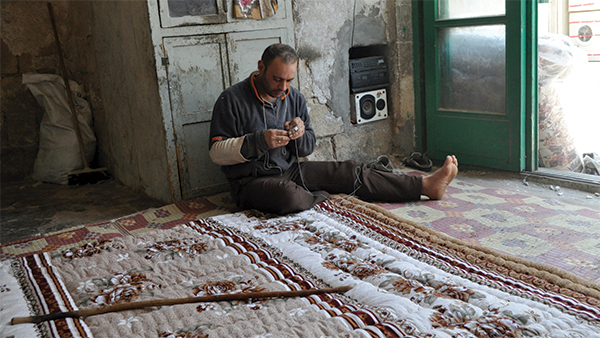
As Nizam continued to hug the duvet, he said with passion: “This duvet belongs to an old lady in a village west of Nablus. Her son brought 6 double duvets and 3 single ones. He also brought 5 mattresses and 10 pillows.” They have a wedding in two months.” He finished his sentence with a big smile. “I love contributing to people’s lives. It is nice to think that this work will be enjoyed by people who will dance over the mattresses with joy. It is wedding time!”
In Palestine, it was important that every family had enough mattresses, pillows, and duvets for guests who came to sleep over. For weddings and other happy or sad occasions, people used to stay for days to support and share the important life events. This, of course, required a supply of clean and fluffy bedding for guests.
“It is important for me at this stage to teach this profession to one of my sons. The youngest wants to learn it, he is showing a lot of interest in learning the details. He once counted the number of stitches on one double duvet, and it was a shock for me to know that there were 1,357!”
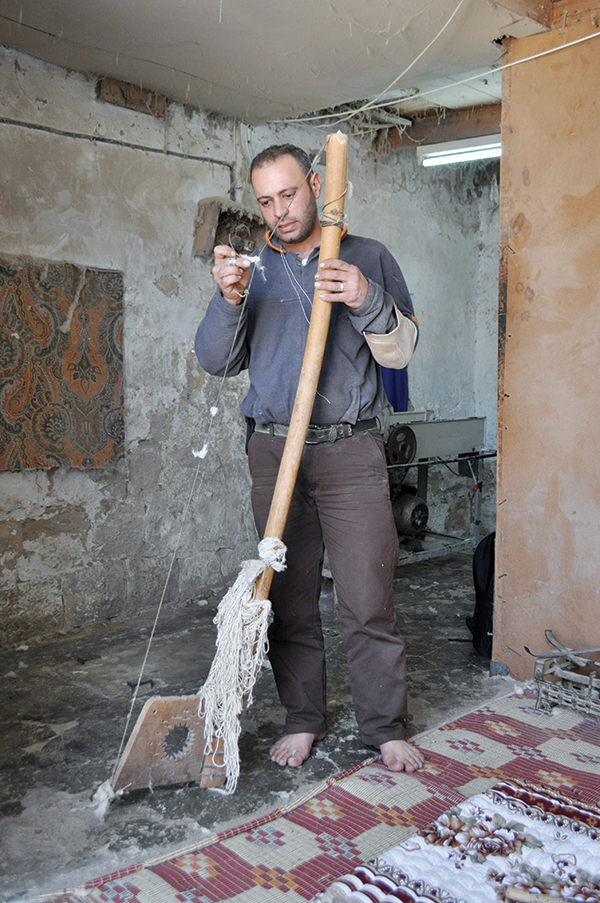 Nizam didn’t finish school. During the first Intifada, he decided that he would stay in the shop with his father and learn how to fluff properly and then take over.
“I want to teach my son the spirit of the profession. I want him to finish school and graduate with a good degree. He might then decide that he wants to take over and preserve the family business, but this is his decision. There are only two of us left in the whole area who make wool bedding. I am the youngest and if I pass away, it is gone!”
He straightens the duvet as he finished sewing, saying: “I like my fluffy business. The joy of my life as a kid was to fluff the wool and cotton. I’ve now grown up and it is still my joy and happiness. Using my needle, thimble, and threads I would have a work of art that competes with the best factory in town that uses machines.”
“I make my duvets with love. The machines can’t. That’s why only one of my duvets will keep you as warm as two factory-produced duvets.”
» Doha Al Wazany was born and raised in the United Arab Emirates. She holds an MA in translation and interpretation from the American University of Sharjah. She is a public relations and digital communications strategist with 10 years of professional experience in the UAE, and she is passionate about Palestine, books, photography, and hiking.
Article photos courtesy of Doha Al-Wazany.